Basic music terms form the foundation of how musicians understand, create, and communicate music.
Whether you are a beginner learning your first instrument or an experienced performer refining your technique, knowing these essential concepts allows you to read music more confidently, collaborate with others effectively, and express ideas clearly during rehearsals or performances.
Music may feel intuitive at times, but behind every melody and rhythm lies a structured system of terminology. From written notation to performance instructions, basic music terms provide a shared language that connects musicians across genres, cultures, and skill levels.
Mastering these concepts does not limit creativity; instead, it empowers musicians to explore it with clarity and purpose.
This guide breaks down the most important musical concepts in a practical and approachable way, helping you build a solid theoretical base while improving real-world musical skills.
Basic Music Terms And The Foundations Of Musical Structure
Musical structure refers to how sounds are organized over time to form meaningful compositions.
At the core of this structure are fundamental concepts such as pitch, duration, dynamics, and form. Basic music terms help define how these elements interact to create harmony, rhythm, and balance within a piece.
Pitch determines how high or low a sound is, while duration defines how long it is held. Dynamics describe volume changes, and form explains how sections of a composition are arranged.
Understanding these concepts allows musicians to recognize patterns, anticipate transitions, and interpret music more accurately. When musicians share a clear understanding of musical structure, collaboration becomes smoother.
Whether working in a band, orchestra, or recording session, a shared vocabulary ensures that creative ideas can be communicated efficiently without confusion.
Understanding Notes, Rhythm, And Tempo
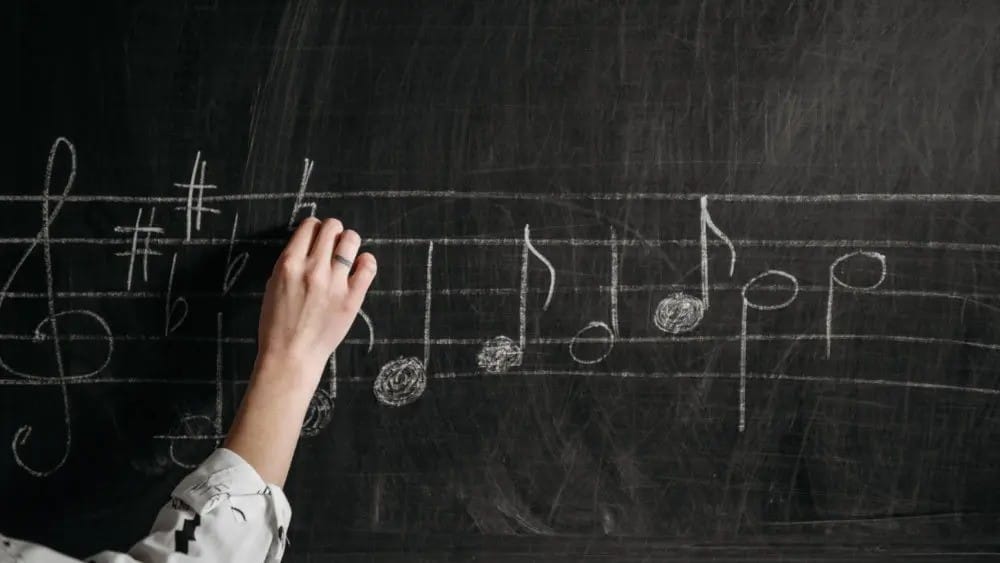
Notes are the written symbols that represent musical sounds, indicating both pitch and length. Learning to read notes is essential for interpreting sheet music and following compositions accurately.
However, notes alone do not create music; rhythm brings them to life. Rhythm organizes notes in time, defining patterns of beats and accents that give music its pulse.
Tempo controls the speed of these rhythmic patterns, shaping the overall mood and energy of a piece. A slow tempo may feel calm or emotional, while a fast tempo can create excitement or urgency.
Among basic music terms, notes, rhythm, and tempo are inseparable. Together, they determine how music flows and how listeners experience it.
Developing a strong sense of timing and rhythmic awareness improves both technical accuracy and expressive performance.
Basic Music Terms: How Chords And Scales Work Together
Scales are sequences of notes ordered by pitch, forming the melodic framework of music.
Chords are groups of notes played simultaneously, providing harmonic support. Understanding how scales and chords relate is essential for composition, improvisation, and accompaniment.
Most chords are built using notes from a specific scale, creating a sense of cohesion within a piece. Major and minor scales, for example, produce different emotional qualities, which are reinforced by the chords derived from them.
Musicians who understand this relationship can predict harmonic changes and adapt more easily during live performances.
Within basic music terms, chords and scales are key tools for musical creativity. They allow musicians to move beyond memorization and begin making informed artistic choices that enhance both structure and expression.
Essential Concepts That Improve Musical Expression

Musical expression goes beyond playing the correct notes. Dynamics, articulation, phrasing, and texture all influence how music feels to the listener. Terms such as legato, staccato, crescendo, and diminuendo guide performers in shaping sound with intention.
These expressive tools help convey emotion and character, turning technical performance into meaningful storytelling.
A single melody can sound gentle, dramatic, or energetic depending on how these concepts are applied. Learning expressive terminology allows musicians to interpret music rather than simply reproduce it.
Basic music terms related to expression play a vital role in developing a personal musical voice. They enable musicians to communicate feeling, nuance, and individuality through sound.
Basic Music Terms For Clear Communication Among Musicians
Music is often a collaborative effort, and clear communication is essential for success. Rehearsals, lessons, and recordings all rely on precise language to convey instructions efficiently.
Basic music terms make it possible to give and receive feedback without ambiguity. When musicians share the same terminology, rehearsals become more productive and misunderstandings are minimized.
Instead of demonstrating every idea physically, musicians can reference tempo changes, dynamic markings, or structural sections verbally. This saves time and keeps creative momentum flowing.
Strong musical communication also builds confidence. Musicians who understand and use proper terminology can participate more actively in group settings, ask informed questions, and contribute ideas with clarity and professionalism.
See you in the next post,
Anil UZUN